
2026 - CASE STUDY
Replatforming VentureBeat
The work ran in two stages. First, I led product design for VentureBeat’s move off a nearly 20-year-old WordPress CMS onto a headless Contentful platform — defining the information architecture, responsive templates, and design system under a tight, fixed deadline. Then I led a team of designers in turning audience data and editorial insight into a redesign concept for the platform’s next chapter.
Impact: Successful MVP launch and approximately 30% growth in returning users after launch
ROLE
Lead Product Designer
TEAM
Product, engineering, editorial, marketing, business
SCOPE
Website migration, responsive product design, design system
RESPONSIBILITIES
Discovery, requirements, IA, user flows, wireframes, UI, documentation

STAGE 1
Replatforming under a hard deadline
Migrating nearly two decades of publishing — 130,000+ articles — from an aging WordPress CMS to a headless Contentful stack, while preserving every URL, SEO ranking, and editorial workflow. Two immovable deadlines framed every design decision.
CONTEXT
A newsroom that outgrew its platform
VentureBeat is a high-volume technology publication supporting articles, news, events, videos, sponsored content, topic pages, author profiles, and other editorial formats.
The website had grown over nearly two decades on a WordPress CMS stretched well past its original purpose — rigid content structures, inconsistent visual patterns, and a platform that made any broader redesign hard to scale. Moving to a headless Contentful stack was the chance to rebuild the underlying product foundation rather than simply reproduce the legacy site.
Articles
News
Events
Videos
Sponsored content
Topics
Authors
Jobs
Newsletters
Legacy Pages
Ten-plus content types, each with its own structure, hierarchy, and responsive behavior.
THE PRODUCT CHALLENGE
Three problems, one migration
01 · A fragmented reader experience
Similar content types used inconsistent hierarchy, navigation, modules, and responsive behavior.
02 · A complex publishing ecosystem
The product needed to support many page types, commercial requirements, editorial formats, live events, video, sponsored content, and legacy content.
03 · Migration without disrupting the business
Over 130,000 articles spanning ~20 years had to move without breaking SEO, URLs, or editorial workflows — against a six-week investor demo and a hard hosting cutoff. I had to define an achievable MVP that protected the business.
How might we migrate a large publishing platform while creating a more coherent reader experience — and a system that could support future growth?
Constraints
130,000+ legacy articles
Many page types and edge cases
Multiple stakeholder groups
Advertising and sponsored-content requirements
Desktop and mobile responsiveness
Two hard deadlines: demo + cutoff
MVP vs. future-state scope
MY ROLE & OWNERSHIP
End-to-end product design ownership
I was the primary product designer for the migration. I translated business and editorial needs into product requirements, mapped the platform architecture, designed responsive experiences, established the design system, and worked closely with engineering through implementation and launch.
I also helped identify and introduce the engineering team that ultimately implemented the migration.
Discovery
Requirements
Architecture
Flows
Templates
Design system
Handoff
QA
Launch
UNDERSTANDING THE SYSTEM
Mapping the platform before designing it
I inventoried the existing website, grouped content and page types into families, identified which templates shared structures and which required unique logic, and separated MVP requirements from future-state improvements.
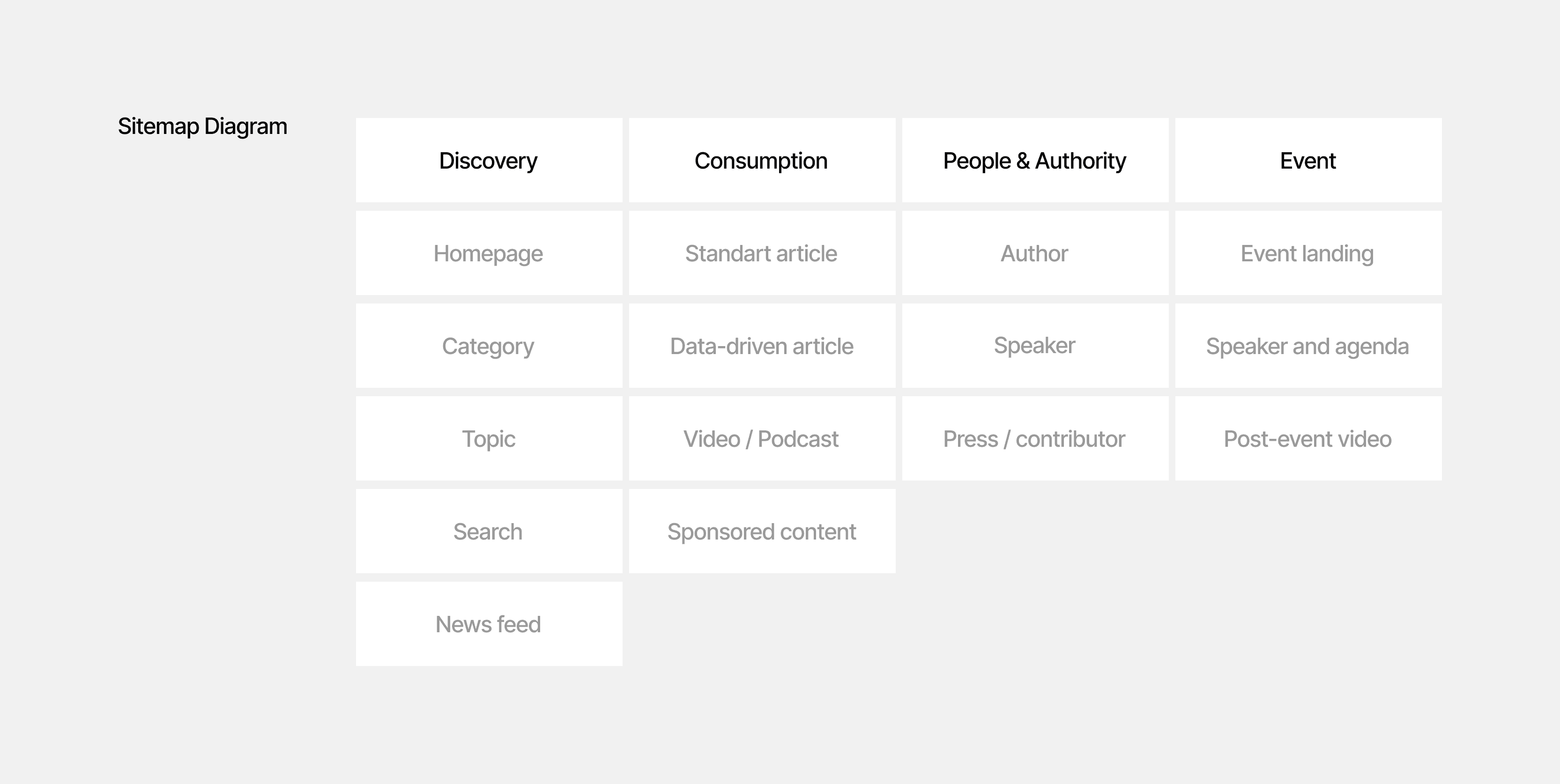
I mapped the existing platform to understand relationships between content types, identify reusable structures, and define the minimum template set required for migration.
Simplified reconstruction based on project documentation and final designs.
PRODUCT PRINCIPLES
Four rules that guided every decision
Content comes first
The system should support scanning and reading without competing with editorial content.
Consistency without sameness
Templates should share predictable behavior while accommodating different content formats.
Design for real publishing conditions
Layouts needed to work with unpredictable titles, media ratios, metadata, ads, and article lengths.
Build the foundation, not a collection of pages
Every decision should contribute to reusable patterns and future platform growth.
DEEP DIVE 01
The article experience
Rather than treating every page as a separate design problem, I identified shared structures — navigation, content cards, metadata, article bodies, related content, promotional modules, and footer patterns — and used them to create a flexible family of templates.
Key decisions
Reading hierarchy
A single typographic scale for headlines, decks, and body across all article variants.
Author & publishing metadata
Consistent byline, timestamp, and category patterns readers can rely on.
Media treatment
Predictable rules for lead images, embeds, and unpredictable aspect ratios.
Advertising positions
Fixed, content-aware ad slots that protect reading flow and revenue.
Related content
Shared recirculation modules across long-form and short news formats.
Controlled variation
Long-form, news, data-driven, video, and sponsored variants from one framework.
DEEP DIVE 02
One system for the entire event lifecycle
VentureBeat runs live events alongside daily publishing. Instead of designing each event page independently, I built an event framework covering discovery, landing pages, speakers, event-related editorial, and post-event video — with clear rules for what stays consistent and what adapts.


THE DESIGN SYSTEM
Built alongside the templates, not after them
Patterns were tested against real content and edge cases, then generalized into reusable components. This kept the system grounded in actual publishing needs — and made template assembly and engineering implementation faster and more predictable.

What the system solved
Unified typography & spacing
Consistent navigation & interaction states
Flexible cards for every content format
Shared metadata patterns
Standardized promotional & editorial modules
Predictable responsive behavior
Faster template assembly
More predictable engineering implementation

COLLABORATION & IMPLEMENTATION
Aligning five groups around one system
Editorial
Content hierarchy and publishing requirements
Business
Monetization and sponsored content
Marketing
Brand and promotional needs
Product
Scope and prioritization
Engineering
Feasibility and implementation
What I documented
Product requirements and template specifications
Responsive states and user flows
Component behavior and content rules
Edge cases across content types
Handoff and implementation review notes
How it shipped
Worked with engineering from requirements through QA
Reviewed implementation against specs, template by template
Resolved edge cases and inconsistencies during build
Kept MVP scope separate from the future-state redesign
Supported the team through launch
STAGE 2
From a stable platform to a data-driven redesign
With the migration shipped, the goal shifted from preservation to progress. I moved into a design-lead role — gathering audience data and editorial insight, then guiding a team of designers to shape a redesign concept for VentureBeat’s next chapter.
DISCOVERY & DATA
Letting the data set the redesign agenda
The migration preserved the business; the next question was how to grow it. I synthesized analytics, on-site behavior, and editorial feedback to understand how readers actually moved through the site — then turned those findings into a focused set of redesign priorities the team could build against.
Return, don’t bounce
Growth depended on winning repeat readers, not one-off search traffic — so the redesign optimized for habit: clear sections, related reading, and newsletters.
Scannability over density
Readers skimmed headlines and metadata before committing. Templates needed stronger hierarchy and breathing room, not more content per screen.
Mobile-first consumption
A majority of sessions were mobile. Every template decision was pressure-tested against small screens before desktop.
Events as a growth surface
VB Transform and event content were underserved by the old layouts — a clear opportunity to convert readers into attendees.

30%
The launch contributed to an almost 30% increase in returning users — alongside a successful website and CMS migration.
OUTCOME & REFLECTION
The launch that proved the system
Successful website and CMS migration
Cohesive responsive experience across major content types
Reusable design system for a complex publishing platform
Shared foundation for future website development
Better alignment across product, editorial, business, and engineering
Migrating a complex platform is not simply a visual redesign. The most important work was deciding what needed to remain stable, what could be improved within the MVP, and how to establish a system that would not reproduce the limitations of the legacy product.
Given more time, I would have introduced more structured usability testing and post-launch behavioral analysis to validate specific template and navigation decisions.